
Local SEO covers every step a dental clinic takes to make its practice details accurate and findable across directories, maps, and search platforms. For a busy clinic, that work spans the Google Business Profile, citation listings, on-site content, and patient reviews. This guide explains what each component involves, what a practice manager can check without outside help, and where professional support is worth considering.
Key Takeaways
| The question | The answer |
|---|---|
| What does local SEO actually involve for a dental clinic? | Four separate pieces of work: the Google Business Profile, citations across directories, on-site pages naming the service area, and patient reviews. Each can be audited on its own, and a provider should be able to describe which ones they touch. |
| Can I check the state of things myself first? | Yes, in about an hour. Search the practice name on the main directories, write down the name, address and phone each one shows, and note every discrepancy. That list is what any provider would start from. |
| What should make me walk away from a provider? | A promised position in search results. Nobody can keep that promise, and a pitch that opens with one is describing something other than the work. |
| Is this a subscription? | It does not have to be. Submitting and correcting listings is finished work. Data drifts after a move, a rebrand or a phone change, and re-checking it is a job ordered again when needed rather than a fee that runs in the background. |
| My practice moved or changed its number. Where do I start? | With a cleanup order, before submitting anything new. Building new listings on top of old details spreads the wrong information further. |
| Does each location need its own listings? | Yes. One profile shared across locations creates conflicting data on every directory that copies it. |
What Local SEO Involves for a Dental Practice
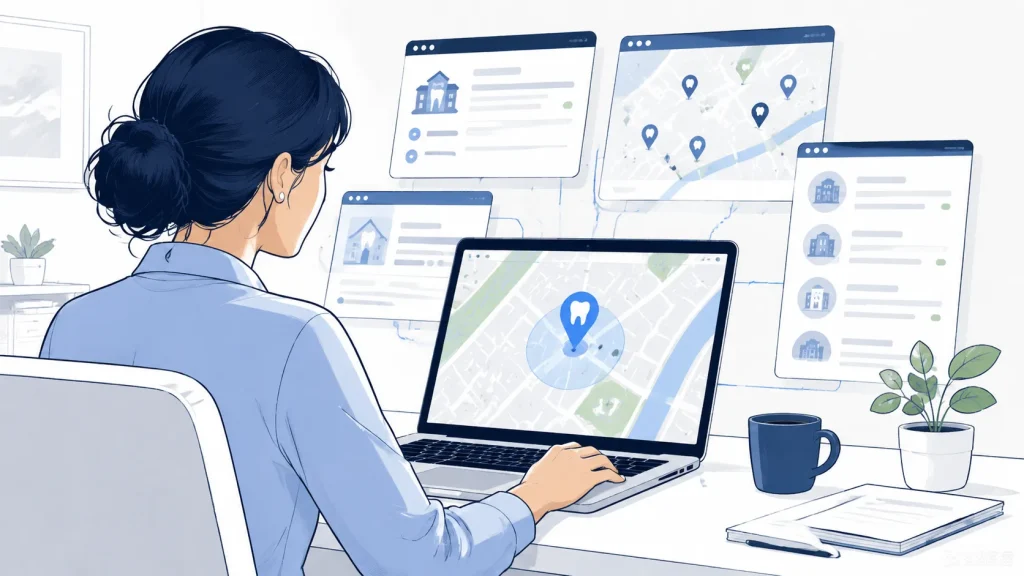
Local SEO for a dental practice covers four main areas: the Google Business Profile, local citations across directories, on-site content that names the service area, and patient reviews. Each area is a discrete piece of work with its own tasks, and each can be audited on its own terms. Understanding the pieces separately is the first step to judging whether a provider is selling you real work or a bundle of vague activity.
The Core Components
The Google Business Profile is the panel that appears when a patient searches the practice name on Google or Google Maps. Local citations are entries on directories such as Yelp, Apple Maps, Bing Places, Facebook, and Healthgrades. On-site content is what the practice website says about the services offered and the neighborhoods served. Reviews are the running record of patient feedback across those same directories. A broader view of how these pieces fit together sits in this overview of local SEO work beyond listings.
What a Clinic Can Check Itself
A practice manager does not need a provider to see the current state of play. Search the practice name across Google Maps, Yelp, Apple Maps, Bing Places, Facebook, and Healthgrades, and write down the name, address, and phone shown on each. Note any discrepancy. According to Google’s Business Profile guidance, “businesses with complete and accurate info are more likely to show up in local search results”, and if the info is not accurate the profile “might not show up for relevant searches in your area”.
The Google Business Profile itself asks for a primary category (General Dentist, Orthodontist, Pediatric Dentist, and so on), services, hours, accepted payment types, and photos of the interior, exterior, and team. Every field the profile offers is a field to complete.
Takeaway: Before buying any work, spend an hour searching your practice name across the main directories and writing down what each one shows.
What to Look for When Evaluating Local SEO Work
Once you know what local SEO covers, judging a provider becomes a matter of matching their scope to those four areas.
Google Business Profile Completeness
A complete profile includes business name, address, phone, website, hours, services listed individually rather than in a block, a practice description, and photos covering the interior, exterior, and team. A provider offering Google Business Profile work should walk you through each of those fields, not just claim to “optimize” the profile.
Citation Accuracy Across Directories
Citation accuracy means the practice name, address, and phone match on every directory where the clinic appears, with no abbreviation differences such as “St” versus “Street” between listings. Ask a provider how they check for existing conflicting entries before submitting new ones, and how they handle a directory that lists an old suite number.
On-Site Local Content
On-site local content should include a dedicated page for each service offered, each page naming the city served and using terms patients actually search for, such as “emergency dentist in [city]” or “teeth whitening near [neighborhood]”. The site footer should carry the same address that appears on the profile, and the contact page should embed a map.
Review Management Process
A review management process covers how the clinic asks patients for reviews, how quickly it responds to existing ones, and whether the responses are personalized rather than templated. A duplicate listing means the same business appears twice, with different review counts on each, which can confuse patients navigating between them.
Takeaway: Judge a provider by whether they can describe the specific fields, directories, pages, and responses they touch, not by the size of the number in their sales pitch.
Local Citations: What They Are and Why Accuracy Matters
A local citation is any online mention of a business’s name, address, and phone number, whether on a general directory like Yelp or a health-specific platform like Healthgrades or Zocdoc. Citations exist whether or not the practice created them; the question is only whether the details are correct.
Where Dental Clinics Typically Appear
Dental-specific directories worth checking include Healthgrades, Zocdoc, WebMD Health Services, RateMDs, and the American Dental Association member finder, in addition to general directories such as Yelp, Apple Maps, Bing Places, Facebook, Foursquare, and Nextdoor. The full set that applies to dentists is published, and the list a provider works from should be inspectable before you order.
What Inaccurate Citations Look Like in Practice
Inaccurate citations commonly result from a practice relocation where only some directories were updated, a phone number change after a switch to a new phone system, or a name change after a rebrand or ownership transfer. Correcting citations starts with listing every directory where the practice appears, recording the name, address, and phone shown on each, and comparing those details against the practice’s current official information. It is a discrete order, not something a clinic needs to sign up to indefinitely.
Submitting to up to 350 citations is achievable through a one-time citation submission order, and around 80% of submitted listings typically go live.
Takeaway: Ask any citation provider for the directory list, the audit output, and the go-live rate for their submissions.
A Worked Example: Harrow Lane Family Dental

Harrow Lane Family Dental is a composite example, not a real client, and the figures in it are invented for the illustration. Only the method is real. It illustrates what a typical citation and profile audit uncovers at a multi-location practice.
The Problem Found at Each Stage
At the profile audit stage, the clinic’s Google Business Profile listed an old phone number from before a 2022 relocation. The address on Yelp still showed the previous street name. Bing Places had no listing at all. Two other directories carried the correct address but the wrong suite number.
What the Cleanup Involved
The citation cleanup stage took roughly two weeks of manual outreach. The team corrected 34 listings, submitted 180 new directory entries through manual citation submission, and flagged two duplicate listings for removal. The on-site content review found that three service pages, implants, Invisalign, and emergency care, did not mention the suburb name. Each page was rewritten to include the city and the nearest landmark intersection.
Where Things Stood at the End
By the end of the process, most directories reflected the current name, address, and phone. One aggregator had not updated its record despite two correction requests. That ticket remained open, illustrating that some directories operate on their own schedules regardless of how the request is phrased.
Takeaway: A realistic engagement ends with most listings cleaned and one or two stubborn ones still in progress. That is normal.
Red Flags: What to Avoid When Buying Local SEO Services

Not every local SEO offer is honest, and some are structured to charge for work that does not need to repeat.
Promises No Provider Can Make
Any provider who guarantees a specific position in search results is making a promise no one can keep. The only honest description of local SEO work is what it involves, not what it produces in search results. If a sales conversation opens with a position promise, treat that as disqualifying.
Subscription Models That Do Not Fit One-Time Work
Citation and listing work is largely one-time: submit accurate information, correct errors, remove duplicates. Recurring monthly fees for static listing data should be questioned. Listing data does drift after staff changes, rebrands, or relocations, and re-checking it is real work. It is a job ordered again when needed, not a service that runs in the background automatically.
Thin or Automated Work
Thin citation work often means a small set of low-quality directories submitted automatically without checking for existing conflicting listings first. Ask how many directories are included, whether duplicates are checked before submission, what the process is for handling rejections, and how the provider handles an existing conflicting listing on a directory they want to submit to.
Takeaway: A provider should describe the process, the directory list, and the handling of exceptions. If the pitch is only an output number, ask what sits behind it.
How to Choose the Right Local SEO Support for Your Clinic
The last step is matching what you now know to your own clinic’s shape.
Criteria Worth Applying
Evaluate providers against five criteria:
- Directory count covered, and which directories specifically.
- Process for handling existing conflicting listings.
- Transparency about which listings went live and which did not.
- Policy on duplicate listings.
- Whether the work is one-time or subscription-based.
Matching Service Scope to Clinic Size
A single-location general practice has different needs from a multi-location group. A multi-location clinic should confirm the provider can handle separate profiles and citation sets for each address, with no cross-contamination between suite numbers or phone lines. A single-location practice can start smaller.
One-time citation submission with one-time pricing from $5 suits clinics that want accurate listings without committing to a recurring contract; the work is discrete and auditable, and the local citations packages spell out what is included. Clinics that have recently relocated, rebranded, or changed phone numbers should prioritize a cleanup order before submitting new citations, to avoid propagating the old details further.
Takeaway: Pick a provider whose scope matches your clinic’s shape today, and order cleanup first if any details have changed in the last two years.
Frequently Asked Questions
How is a citation different from a Google Business Profile?
A Google Business Profile is the panel Google itself shows for your practice. A citation is any other online mention of your name, address, and phone number on a directory such as Yelp, Healthgrades, or Bing Places.
What directories should a dental practice be listed on?
General directories such as Yelp, Apple Maps, Bing Places, Facebook, Foursquare, and Nextdoor, plus dental and health directories such as Healthgrades, Zocdoc, WebMD Health Services, RateMDs, and the American Dental Association member finder.
How do I find and fix duplicate dental practice listings?
Search your practice name on each major directory and note any second entry with a different address, phone, or review count. Contact the directory through its listed correction or claim process to request a merge or removal.
Does a dental practice need separate citations for each location?
Yes. Each physical location needs its own profile and its own citation set, with the address and phone number specific to that location. Sharing one profile across locations creates conflicting data on directories.
How often should a dental clinic re-check its citation data?
Re-check after any change to the practice: a relocation, a phone number switch, a rebrand, a new suite number, or a change in hours. Absent a change, an occasional review is enough. It is a job to order again when needed.
Can a dental clinic do citation work itself, or does it need a provider?
A clinic can audit and correct listings itself. It is time-consuming but not technical. A provider is worth considering when the directory count is large, when duplicates need merging, or when the practice has recently moved.
What should be included in a complete Google Business Profile for a dentist?
Business name, address, phone, website, hours, the correct primary category (General Dentist, Orthodontist, Pediatric Dentist, and so on), each service listed individually, accepted payment types, a practice description, and photos of the interior, exterior, and team.
Sources
Google Business Profile Help, “Improve your local ranking on Google”, at support.google.com/business/answer/7091. Used for the single quoted statement about complete and accurate information, and for nothing else. Checked 5 September 2026.
Figures about our own service, meaning order volume, the citation cap, and the share of submitted listings that go live, come from our records. The figures inside the worked example are invented for the illustration and are labeled as such where they appear.
No other external source is cited. The directory names in this article are a list of where dental practices commonly appear, drawn from our own submission work rather than from a published ranking of directories.
How This Guide Was Made
Local Citation Services sells citation building, citation cleanup and Google Business Profile work, so there is a commercial interest behind this guide. That is stated in the opening and it is worth repeating here.
The guide describes what the work involves and what a clinic can check for itself. It does not say what any of it produces in search results, because that is not something we can verify, and the one statement on that subject is quoted from Google’s own documentation and linked.
The directories named here are listed because dental practices appear on them, not because we rank them against each other. A provider’s own directory list is the thing to ask for.

Founder, Local Citation Services and Local SEO Expert
Sharif has built local citations by hand since 2009, across 24,000+ orders and 50+ countries. He leads the team that submits every listing manually, checks what already exists before adding anything, and reports back with a live URL and a login for each one. He writes about what the work actually involves, what goes wrong, and what a business owner can check for themselves without buying a tool.