
A Google Business Profile optimization checklist gives new and multi-location businesses a repeatable process for completing and correcting their listing on Google Search and Maps. Local Citation Services works through that process from claiming a profile to building the supporting directory entries that keep location data consistent, and the local directory submissions behind it are what hold the details in place. This guide follows one fictional business, Thornfield Bakery, through each checklist stage, naming the specific problem found and what was done about it.
What You Will Need Before You Start

Before opening the Business Profile editor, gather everything the checklist will ask for. Half-finished edits are the reason most first passes stall.
Access credentials and profile ownership
You need a Google account with the Owner or Manager role on the profile. Without one of those two roles, most fields are locked and verification cannot be completed. If the profile is unclaimed, you will go through the claim flow first; if a former employee owns it, request ownership transfer through Google’s built-in form before touching anything else.
A service-area business must decide which cities or zip codes to list before opening the editor. Changing service areas on a live profile can trigger a re-review, so settle the coverage map on paper first.
Supporting documents and assets to have ready
Collect the exact legal business name, primary phone number, website URL, and all location addresses in one document before touching any field. This prevents the common mistake of typing the trading name in one field and the legal name in another.
Have at least five photos ready: exterior, interior, team, product or service, and a logo file. Each photo type occupies a different slot on the profile, and a logo-only listing reads thinner than one showing the premises and the people.
If the business already appears on other directories, list those addresses now. Any mismatch you find later becomes a separate citation cleanup job rather than a two-minute edit inside Google.
Takeaway: Assemble credentials, exact business details, and five asset types before you open the editor. Field-by-field editing without a source document is how inconsistencies enter the profile.
Before You Start: Back Up What Is Already There
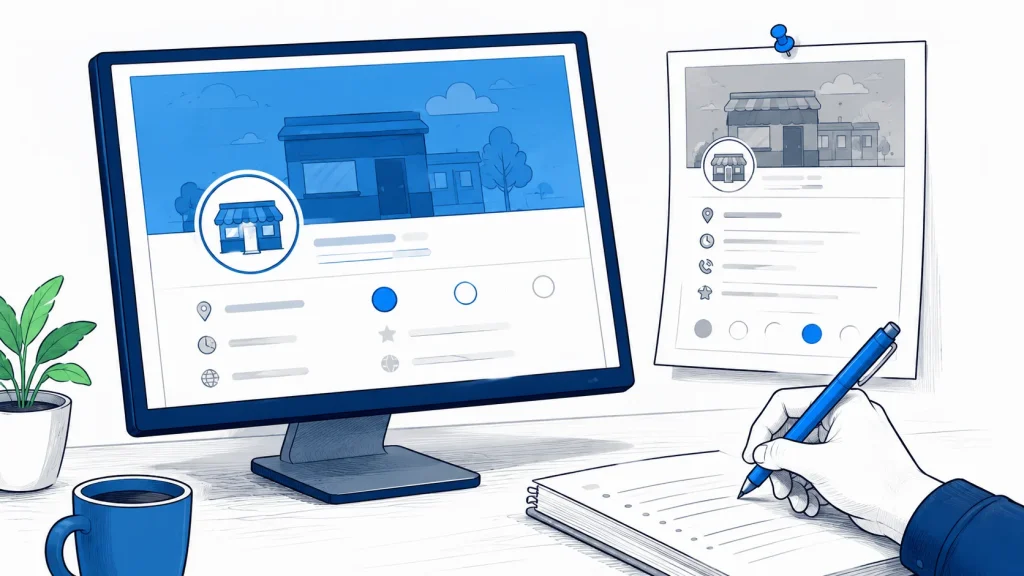
Optimization is destructive if you skip this step. A category change or a name edit can remove data you did not know was there.
What can change unexpectedly
- Business name, address, or category edits can trigger re-verification. Note the current values in a text file before changing anything, so you can restore them if the edit is rejected.
- A category change on an established profile can remove attributes that were previously set. Screenshot the attributes panel first so you can re-enter the ones that disappear.
- Q&A entries and owner responses occasionally disappear after bulk edits. Copy them into a local document.
- Multi-location accounts should export the location list from Business Profile Manager before making group edits, so a bad bulk change can be reversed row by row.
Takeaway: Screenshot the attributes panel, copy Q&A locally, and export the location list. These three artifacts let you rebuild after any edit that goes sideways.
Step-by-Step: Working Through the Optimization Checklist

Work top to bottom. Each step depends on the previous one being accurate.
Step 1: Claim and verify the profile
Search for the business name and city on Google. If a profile already exists, click “Own this business?” and follow the claim flow. Verification is usually by postcard, phone, email, or video, and the option offered depends on the category. You should now see the profile inside Business Profile Manager with an “Owner” badge.
Step 2: Complete foundational information
Enter the business name exactly as it appears on your signage and legal paperwork, without extra keywords. Add the full address (or service areas), primary phone, website, and hours including holiday hours. Google’s own guidance states that “businesses with complete and accurate info are more likely to show up in local search results”, and that if it is not accurate the profile “might not show up for relevant searches in your area” (Google Business Profile help).
Step 3: Choose categories and add services
The primary category is the most specific field on the profile. “Plumber” describes the business more precisely than “Home Services”, and only one primary category can be set. Add secondary categories only when the business genuinely offers that service. Then fill in the Services list using the words customers actually type.
Step 4: Add photos, videos, and attributes
Upload the five asset types from your prep folder. There is a limit on how many photos a profile can hold, but the priority is coverage of the five types, not volume. In the attributes panel, tick only what applies (wheelchair accessible, veteran-led, outdoor seating, etc.). You should now see the profile preview showing your photos in the correct order.
Step 5: Set up posts, Q&A, and conversion links
Publish an opening post so the profile does not look dormant. Standard update posts expire after a period; event posts remain until the end date. Seed the Q&A section with a handful of accurate owner-answered questions, because the section is public and anyone can post an answer. Conversion links (booking, ordering, appointment) are category-dependent and will not appear for every business type.
Step 6: Request, monitor, and respond to reviews
Send existing customers the short review link from the Business Profile dashboard. Respond to every review, positive and negative. Responding to reviews, positive and negative, is worth doing: the response appears publicly next to the review. This is where a broader local SEO workflow starts to matter: reviews arrive continuously and each response is a small piece of copy.
Takeaway: One primary category, five photo types, seeded Q&A, and a reply on every review. Everything else is refinement on top of those four.
Following One Business Through the Checklist: Thornfield Bakery
Thornfield Bakery is a composite example, not a real client. It is a single-location retail shop. Here is what the owner found at each stage.
What Thornfield found at each stage
Claim step. The profile had been auto-generated by Google with a phone number pulled from an old directory listing. The number rang through to a disconnected line. The owner had never claimed it. Claim and postcard verification were completed on the first attempt.
Foundational info. The website field was blank and the hours listed Sunday as closed, when the bakery had started Sunday trading the previous spring. Both were corrected in the same session.
Categories. The team had originally selected “Restaurant” as the primary category instead of “Bakery”. The booking option shown in the editor was a restaurant reservation widget rather than a custom-order form, which is what the bakery actually needed. Switching the primary category to “Bakery” changed the available conversion options.
Photos. The photo audit revealed zero interior shots and only one exterior photo, taken in winter. The profile showed a dark storefront with no indication of the product range. The owner shot the missing four types on a Tuesday morning before opening.
Q&A. A user had posted “Do you do custom cakes?” nine months earlier with no owner answer. Three community answers gave contradictory information. The owner answered directly, then seeded four more common questions (allergens, order lead time, delivery radius, gift vouchers).
The honest detail at the end
After completing every checklist step, the business name on Yelp still read “Thornfield Bakes”, the old trading name from before the rebrand. The Google profile was clean. The wider directory footprint was not. That mismatch is a citation building job, and the GBP checklist alone could not fix it.
Takeaway: The checklist ends at the profile edge. Anything that lives on Yelp, Apple Maps, or Bing Places is a separate job.
Troubleshooting Common Checklist Failures

Five failures come up often enough to list.
- Symptom: Verification postcard never arrives. Cause: The address entered differs slightly from the official postal address (a missing unit number, an abbreviation). Fix: Check the address field character by character against the postal record, then request a new postcard.
- Symptom: Edits revert within 24 hours. Cause: A third-party data aggregator is pushing the old information back into Google. Fix: Identify the source directory and update it there; a cleanup job can locate the source when it is not obvious.
- Symptom: A category change removed previously set attributes. Cause: Some attributes are category-specific and do not carry over. Fix: Re-open the attributes panel after every category change and reselect what applies.
- Symptom: Profile is suspended after a name or address edit. Cause: The edit flagged an inconsistency with Google’s data. Fix: Use the reinstatement form inside Google Business Profile support and attach documentation such as a utility bill or business license.
- Symptom: A duplicate profile appears in search results. Cause: An old unclaimed listing exists alongside the claimed one. Fix: Open the duplicate on Maps, choose “Suggest an edit”, and mark it as a duplicate or permanently closed.
What to Check When the Checklist Is Complete
Do not rely on the editor view. Use “Preview” mode inside Business Profile Manager to see the profile as a searcher on Google Maps would, including which buttons appear on mobile.
Check the “Info” tab for Google-suggested edits that are pending.
Cross-check the business name, address, and phone number against at least three major directories (Yelp, Apple Maps, Bing Places). Any inconsistency is a separate job from GBP optimization, and a broader Google Business Profile boost engagement is where the wider directory work usually happens.
Revisit the checklist whenever a business detail changes: new phone number, seasonal hours, an additional location, or a change in services. Business Profile Manager also shows performance data (searches, map views, direction requests). Use that data to see which sections users interact with, and prioritize future edits accordingly.
Takeaway: Preview mode, the Info tab, and a three-directory cross-check are the three post-checklist verifications. The performance panel tells you what to edit next.
Frequently Asked Questions
How do I know if my Google Business Profile has already been claimed by someone else?
Search the business on Google and click the profile. If you see “Own this business?” it is unclaimed. If that option is missing, it is claimed, and you will need to request access through Google’s ownership transfer form.
What should I do if my profile keeps reverting to old information after I edit it?
Old information usually comes from a third-party directory that Google’s data aggregators still trust. Identify which directory holds the stale record, correct it there, then re-edit the Google profile. The revert should stop.
Can I use a Google Business Profile if my business has no physical storefront?
Yes, if you meet customers in person at their locations. Register as a service-area business and list the areas you cover. Purely online businesses with no in-person contact do not qualify for a profile.
How often should I go back through the optimization checklist?
Run the full checklist whenever a detail changes: new phone number, address, hours, services, or an added location. Between changes, check the Info tab for pending Google-suggested edits and review new Q&A entries.
What is the difference between a primary category and a secondary category on Google Business Profile?
The primary category is the single best description of what the business does and only one can be set. Secondary categories cover additional services the business genuinely offers. Add secondary categories sparingly, only for real service lines.
Do I need a separate Google Business Profile for each location of my business?
Yes. Every physical location that meets customers in person needs its own profile, managed under one Business Profile Manager account. Group edits are possible, but each location keeps its own reviews, photos, and Q&A.

Founder, Local Citation Services and Local SEO Expert
Sharif has built local citations by hand since 2009, across 24,000+ orders and 50+ countries. He leads the team that submits every listing manually, checks what already exists before adding anything, and reports back with a live URL and a login for each one. He writes about what the work actually involves, what goes wrong, and what a business owner can check for themselves without buying a tool.