
On this page
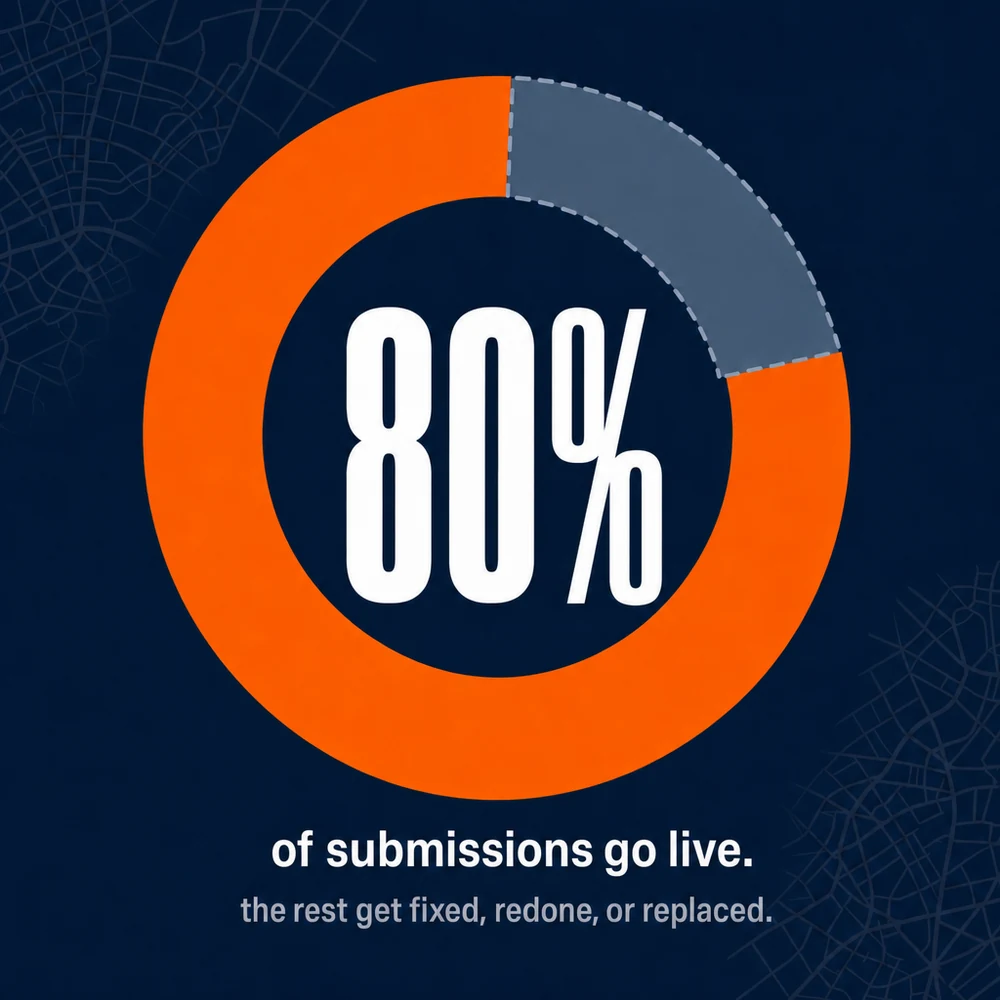
That 80% figure is the number most providers avoid putting in writing. Here is where it comes from, what the full timeline looks like, and which parts of it anyone can actually influence.
The two clocks nobody explains before you buy
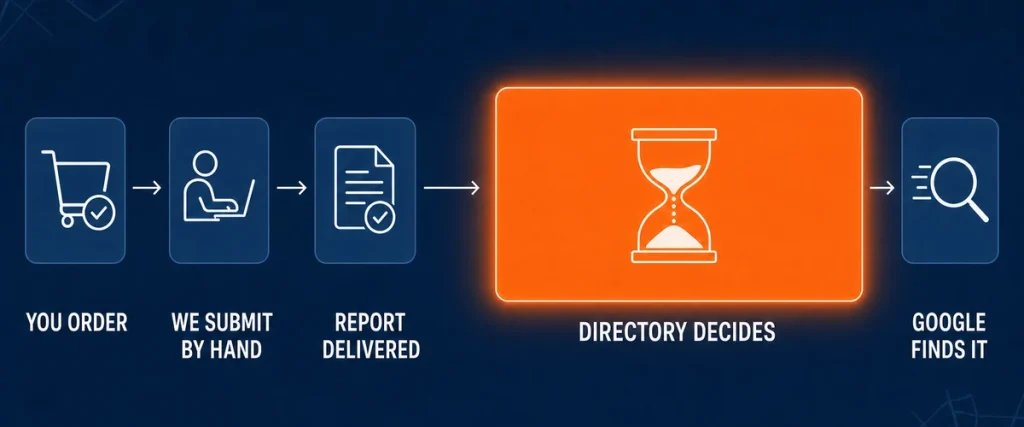
When you order citations, two separate processes run, and only one of them belongs to the person you paid.
The first is submission. Someone opens the directory, enters your business name, address, phone number, category, description, hours, and images, then submits. Multiply that by 80 or 200 or 350 directories and the work is measured in days. Our standard packages run 5 days for 15 citations up to 16 days for 350, and Fast Delivery compresses the same manual work into 2 to 5 days by moving your order to the front of the queue.
The second clock belongs to the directory. Your listing lands in their system and waits for whatever process they run. Some publish immediately. Some route it to a human moderator. Some mail a postcard to your address or call your phone before anything appears publicly. A handful never respond at all, because the site has been quietly abandoned by whoever built it.
Practical rule: You are buying the first clock. Nobody sells the second one, and any provider quoting you a guaranteed live date is quoting a number they cannot control.
What the timeline actually looks like, order to live listing
| Stage | Who controls it | Typical duration |
|---|---|---|
| Order placed, details submitted | You | 5 minutes |
| Manual submission across your directory list | Us | 5 to 16 days standard, 2 to 5 days Fast Delivery |
| Report delivered with every URL and login | Us | Same day the submissions finish |
| Directory review and approval | The directory | Instant to several weeks |
| Search engines crawl the live listing | Google and others | Days to weeks after it goes live |
The important row is the fourth one. Your report arrives when the work is finished, not when every listing is visible. A good portion will already be live. The rest appear over the following days and weeks as moderators work through their queues.
This gap is normal, and it is the single most common source of confusion for first-time buyers. If you check your report the day it lands and count live listings, you are counting too early.
What Google’s own verification timelines tell us
Google Business Profile is not a citation in the ordinary sense, but it is the one listing everyone checks first, and its published timelines are a useful reference point for how directory verification behaves generally.
Google’s own Business Profile documentation states that verification review can take up to 5 business days after you complete the steps, and that most mailed verification codes arrive within 14 days. The method decides almost everything: phone and email verification finish in minutes, video verification usually takes 1 to 5 business days for review, and postcard verification runs 5 to 14 days for delivery alone, longer for remote or international addresses. The code then expires after 30 days if nobody enters it.
Smaller directories run lighter versions of the same idea. A phone call, an email confirmation, a moderator glancing at your submission. The pattern holds: automated checks are fast, human checks are slow, and physical mail is slowest.
Working standard: if a directory needs to confirm you exist at the address you claim, expect two weeks, not two days.
How each verification type behaves
The method a directory uses tells you more about the wait than the directory’s size does.
| Verification type | What happens | Typical wait |
|---|---|---|
| Instant publish | Submission goes live with no checks | Minutes |
| Email confirmation | You click a link in an automated email | Minutes to hours |
| Phone or SMS code | A code is read out or texted to your listed number | Minutes, if someone answers |
| Video or document review | A person checks footage or paperwork you upload | 1 to 5 business days |
| Postal verification | A code is mailed to your business address | 1 to 2 weeks, longer for remote addresses |
| Editorial review | A human moderator reads the submission and decides | Days to weeks, and sometimes no answer at all |
The bottom two rows are where orders get stuck, and they are also where the listings worth having live.
What happens to the listings that don’t go live on the first pass
Around 80% is our real figure across 24,000+ orders, and we would rather publish it than let anyone assume 100%.
Listings stall or get rejected for reasons that have nothing to do with how carefully they were submitted:
The directory only accepts certain business categories, and yours is not one of them. Or it requires a street address and rejects service-area businesses that work from home. Or the moderator queue is backed up and moving slowly.
Or, and this is the part of the industry nobody advertises, the directory is dying.
Part of the directory web is quietly rotting
Directories are websites, and websites get abandoned. The owner moves on, the moderation queue stops being read, the submission form still works and still says thank you, and nothing that goes in ever comes out. From the outside it looks identical to a slow queue.
You can spot them if you look. Check whether anything has been published on the site in recent months, whether the newest listings in a category are years old, whether the contact address bounces, and whether the site itself still gets updated. A directory with a copyright date three years stale and no new listings since is not going to approve yours.
This is why a directory list has to be maintained rather than inherited. A list assembled five years ago and never revisited will contain sites that no longer approve anything, and every submission sent to one of them is a listing that was never going to go live. Pruning that list is unglamorous work, and it is part of the difference between an 80% live rate and a much worse one.
There is also a version of rejection that works in your favor. Directories with genuine editorial review reject submissions, and that filtering is exactly what makes a listing there worth having. A directory that publishes anything instantly attracts everything, and a listing there is generally worth less than one that had to pass a review.
What happens to the gap on our orders: if a listing does not go live, we fix it, redo it, or replace it, free. If you are still not satisfied after that, the money-back guarantee applies. Either way, 80% is a starting point rather than a final score.
Building citations for a client and need the report to hold up?
Every order comes back with each URL, each login, and the money-back guarantee behind it. See citation packages from $5 →
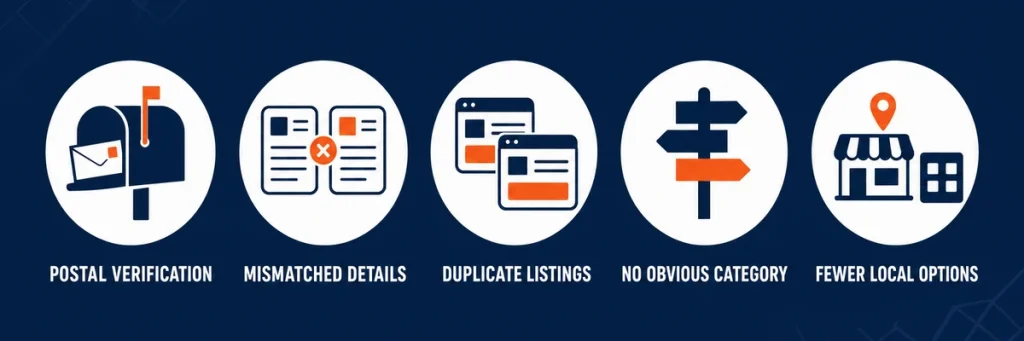
Five things that slow a listing down
1. Verification that needs physical mail
As covered above, postcard verification adds one to two weeks before anything can proceed, and no amount of follow-up speeds up a postal service.
2. Business details that don’t match what’s already online
If your name, address, or phone number conflicts with existing listings, some directories flag the submission for manual review instead of publishing it. This is the practical argument for fixing what exists before adding more, which is what a citation audit and cleanup does.
3. Duplicate listings already on the directory
Half-finished profiles created years ago by a previous agency, a former employee, or an automated scrape have to be reconciled rather than simply overwritten.
4. Category ambiguity
Businesses that fit awkwardly into a directory’s category list get held for review more often than businesses with an obvious slot. Multi-service companies see this constantly. Trade-specific directories usually resolve it, because the categories there are built for the industry rather than for everyone, which is one reason our industry citation guides are organised by trade.
5. Where the business is based
Some markets have deeper pools of local directories than others. We build up to 350 citations in every country we serve, but in markets with fewer local options the mix leans harder on international directories, and those sites run their own review timelines.
What actually speeds things up
Send correct details the first time. Exact business name as it appears on official records, the address formatted the way your postal service writes it, a phone number someone answers, and one clear primary category. Every inconsistency you send is one a moderator has to resolve later, and resolution costs days.
Clean up the existing mess before adding to it. Old addresses and dead phone numbers on existing listings are more likely to get a new submission held for review than to sit harmlessly in the background.
Choose Fast Delivery when the deadline is real. It moves your submissions to the front of our queue, which means your listings enter directory review sooner. It does not change what happens inside that review.
And then leave it alone. Emailing a moderator about a pending submission almost never moves it up the queue, and on some sites the resubmission resets your place in it.
Practical rule: the listings that go live in week three count exactly as much as the ones that went live on day one. Citations compound; they do not switch on.
“It’s been three weeks and half my listings still aren’t showing”
This is the most common message we get, and most of the time nothing is wrong.
Work through it in this order.
Open your report and check the URLs directly rather than searching for your business name. A listing can be live and simply not ranking for your name yet, which looks identical to a missing listing if you only search.
Count how many are actually live versus pending. Around four in five live is a normal outcome for careful manual submission. If you are well below that after a month, something is worth investigating.
Look at what the pending ones have in common. If most of them are directories that mail a code or run editorial review, you are waiting on a queue and the answer is patience. If the pending ones are scattered across directory types with no pattern, the problem is more likely in the submitted data.
Check your business details for a mismatch. One wrong suite number or an old phone number that still appears on other listings will hold submissions up across several directories at once, which is what makes a scattered pattern look random when it isn’t.
Then contact whoever built them. If it was us, reply to your report and we will chase the pending ones, fix what needs fixing, and replace what won’t recover. If it was someone else and they have gone quiet, a citation audit will tell you what actually exists rather than what you were told was submitted.
Practical rule: panic at six weeks, not at three.
Not sure what’s already out there?
Send us your business name and city and we’ll check your top ten directories: which listings exist, which ones disagree with each other, and whether anything needs fixing before you build more. No charge, no obligation.
Get your free listing check →