Local Citation Building for Towing Companies: The Complete Guide
Where a towing company gets listed, which phone number and address belong on each listing, and why the name on the listing has to match the truck and the sign.
Last updated November 2026
8 min read
By the team behind 24,000+ citation orders
Table of contents
- 1What a customer sees when they search “tow truck near me”
- 2What counts as a local citation for a towing company
- 3Where towing companies get listed
- 4What a complete towing listing contains
- 5Three numbers and two addresses: the dispatch tangle
- 6Five listing mistakes towing companies make
- 7How to build towing citations step by step
- 8A worked example
- 9Do it yourself, or hand it off?
- 10Towing citation FAQ
A car is on the shoulder with its hazard lights on, and the driver is searching “tow truck near me” with one eye on the passing cars.
The other kind of towing customer did not choose you at all. Their car was removed from a private lot, and they are typing the name from the sign into a phone to find out who has it and where it went. Both customers need the same thing from your listings: the right name, the right number and the right place.
This guide covers where a towing company gets listed, which number and address go on each listing, the records an order cannot create, and the order to build in.
Key takeaways
| Which phone number goes on our listings? | The dispatch line, on every listing. Put office and yard numbers in the description, labeled. |
|---|---|
| Should the storage yard address be public? | Yes, if that is where vehicles are released, with the release hours. Otherwise use a service area. |
| Can a citation order get us onto a motor club network or a police rotation list? | No. Those come from an agreement with the network or approval by the agency. |
| What can a citation order cover? | Open general and local directories, submitted by hand with the same name, number and address on each. |
| Does the name on the listing have to match the truck? | Yes. Someone searching the name on a sign or a receipt should land on the same business. |
What a customer sees when they search "tow truck near me"
The results page shows a map with a few towing companies and a call button on each. A stranded driver taps the first one that looks open. They will not read a description.
The driver whose car was impounded searches differently. They type the company name from the sign or the receipt, and they need a phone number that reaches someone who knows where the car is, and an address where it can be collected. If the listing shows the office line and the old yard, that customer starts the conversation angry.
What a customer sees. The businesses shown are invented.
The profile behind a map result is your Google Business Profile. Google’s own guidance says that “businesses with complete and accurate info are more likely to show up in local search results”. That sentence is about the profile itself.
Takeaway: A stranded driver needs dispatch. An owner collecting a car needs the yard. Your listings have to send each to the right place.
What counts as a local citation for a towing company
A local citation is any online mention of your business name, address and phone number, often with your website, hours and services. For a towing company the services usually include roadside assistance, light and heavy towing, recovery, and private property towing.
Towing is regulated differently from state to state and city to city. Where the state licenses tow companies, as Texas does through its Department of Licensing and Regulation, the license number belongs on the listing, written the way the public lookup shows it.
Takeaway: A citation is your name, address and phone in public. For a towing company, which phone and which address are the questions that matter.
Where towing companies get listed
The places a towing company appears fall into four groups. What separates them is how a listing gets there.
The four groups, by how a listing gets there.
| Where | What it is | How a listing gets there |
|---|---|---|
| Core profiles | ||
| Google Business Profile | The profile behind map results | You create it and verify it with Google |
| Apple Business Connect, Yelp | The profile behind Apple Maps, and review pages | You create or claim them. Each verifies with the business |
| Bing Places, Facebook | The profile behind Bing, and a business page | An order can set these up. Bing mails a code to the business, which you pass on |
| Networks and rotation lists | ||
| Motor clubs and roadside assistance networks | Networks that send their members’ calls to local tow providers | A provider agreement with the network. Nothing is submitted |
| Police and municipal rotation lists | The lists agencies call tows from | The agency approves and adds operators |
| License and permit records | ||
| State or city tow license lookup | Public record of licensed tow companies and storage facilities, where towing is licensed | The license or permit creates it |
| General and local directories | ||
| Hotfrog, Brownbook, Manta, MerchantCircle, Cybo | General business directories | Open submission. This is what a citation order covers |
| Better Business Bureau | Business record with its own review | Open submission, then the directory reviews it |
| Chamber of commerce and city directories | Local listings | Some are open, some come with membership |
A citation order covers the last group, and it can also set up Bing Places and a Facebook page from the first. Network work and rotation work come from agreements and approvals, and a license record comes from the license. None of them can be ordered.
From our own order reports: general directories such as Hotfrog, Brownbook, Manta, MerchantCircle and Cybo are usually live by the time we deliver the report. Better Business Bureau submissions are usually still in the directory’s own review at that point.
Takeaway: Calls from networks and rotation lists come through agreements. Directories are the part you can hand off.
What a complete towing listing contains
On the profiles you control, a complete towing listing answers two different customers without making either of them call twice. That means it has:
- The dispatch number as the main number. On every listing, with no exceptions.
- The yard address and release hours. If vehicles are released there. A yard that releases cars from nine to five is not open twenty-four hours for that purpose, even if the trucks are.
- The name on the truck doors. And on your lot signs and receipts.
- The license number. Where your state or city issues one, as the lookup shows it.
Takeaway: Dispatch number first, yard address and release hours where they apply, and the name that is on the trucks.
Three numbers and two addresses: the dispatch tangle
A towing company has more contact details than most businesses its size. There is a dispatch line that is answered around the clock, an office line for billing, and often a third number at the storage yard. There is an office address and a yard address, and they are not always the same place.
Every one of those ends up on a listing somewhere. The directory that was filled in by the bookkeeper has the office line. The one created when the yard moved has the new yard, and the others still have the old one.
Which Number? Which Yard. The business and its details are invented.
For a stranded driver the cost is a call to a number nobody answers at night. For someone collecting an impounded car it is worse: a drive to a yard you left two years ago. Towing already carries a reputation problem. The American Transportation Research Institute publishes a state-by-state compendium of towing regulations because of complaints about predatory towing, and an owner who cannot find their car reaches for that word quickly.
The license record is part of this. Where a public lookup exists, an owner or an insurer can check the company name on the receipt against it. If your listings use a different name from the license, the first thing that customer learns about you is that the names do not match.
After a yard move or a change of dispatch line, tracking down the listings that still show the old yard matters more than adding new ones.
Takeaway: Decide which number is the main number and which address is the release address, then make every listing say so.
Five listing mistakes towing companies make
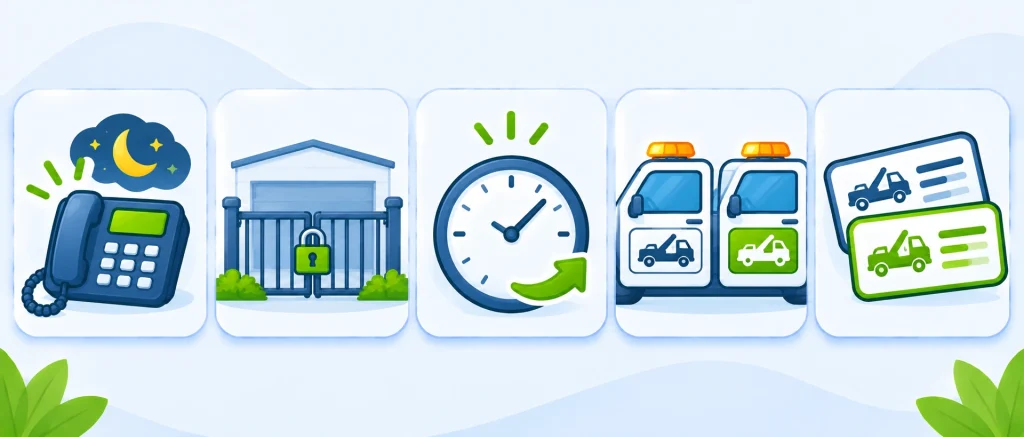
- The office line as the main number. It is the number the bookkeeper knew, and nobody answers it at night.
- The old yard address. The most expensive mistake in the trade, paid by a customer who drives to the wrong place.
- “Open 24 hours” with no release hours. True for the trucks, not for the gate.
- A name that differs from the trucks, signs and license. Someone searching the name on a receipt should find you, not wonder who towed them.
- A second listing for the recovery or heavy-duty side. One legal business is one set of listings, with every service named on it.
How to build towing citations step by step
If you would rather do it in-house, this is the order we would follow.
The build order: fix what disagrees before adding anything new.
- Write down your reference details. The business name as it appears on the trucks and the license, the dispatch number, the current yard address with release hours, and the license number if you have one.
- Set up the core profiles, starting with the ones only you can verify. Google Business Profile, Apple Business Connect and Yelp verify with the business directly, for example with a code sent to the business phone or address, so nobody outside the business can finish them for you. Bing Places and a Facebook page can be set up for you: Bing mails a postcard with a code to the business, and you pass the code on so the listing can be verified.
- Find what already exists. Search your business name, your phone number, and any old address or old name. List every listing you find and mark what is wrong on each.
- Fix before you build. Correct or remove the wrong listings first, so new listings do not sit next to old ones that disagree with them.
- Confirm your network and license records. Check that the motor clubs you work with, any rotation lists you are on, and the state or city lookup all show the current name, number and yard. Each one is corrected through its own contact, not through a form.
- Submit to general and local directories. Use the reference details from step one on every form. Completeness matters more than the count.
- Keep a record. Every listing, its login and its status. You will need it the next time anything about the business changes.
The work is not hard. It is slow and repetitive, and the verification codes for the core profiles go to the business, not to whoever filled in the form.
Takeaway: Settle which number and which address first. The rest is repeating them.
A worked example
This is a composite example, not a real client, and the figures in it are invented for the illustration. Only the method is real.
Harbor Road Towing runs three trucks and a storage yard, and moved the yard across town two years ago. The audit took about two hours and found seventeen listings. Seven showed the old yard. Five used the office line as the main number. Two carried the name “Harbor Rd Tow & Recovery”, which is on neither the trucks nor the city permit.
The reference details were set as the permitted name, the dispatch line, the current yard and its release hours. The owner corrected the Google profile and the two map profiles first, since those verify with the business. The remaining listings were corrected over three days, and the motor club the company works with was sent the new yard address through its provider contact.
One map app kept showing the old yard. The correction was submitted and marked as received, and it had not changed when this example ends. The company put a sign with the new address on the gate of the old yard.
Do it yourself, or hand it off?
Everything above is doable in-house if someone on the team has the hours and the patience for forms. Handing it off tends to make sense when:
- Nobody owns the detail work. Dispatch is answering the phone, and the owner is in a truck.
- You have moved the yard or changed the dispatch line. Every old listing is now sending someone to the wrong place.
- You are an agency with several towing clients. The hours multiply with every client.
- The name has drifted. Abbreviations and add-ons have to be found and corrected one listing at a time.
We submit towing companies to open directories by hand and send a report with every live link and login, so the listings stay yours. We can also set up Bing Places and a Facebook page; for Bing, you pass on the code from the postcard Bing mails to you. Google Business Profile, Apple Business Connect, Yelp and the platforms that verify with the business stay with you, and the report says so where a listing is waiting on a step only you can take. Ordering a set of directory submissions is a one-time purchase, from $5.
Want your towing listings done for you?
Manual submissions, your dispatch number and current yard on every listing, and a report with every live link and login.
Plans from $5 · one-time fee
Money-back guarantee. If we can’t make it right, you get your money back.
Towing citation FAQ
There is no fixed number. Get the profiles you control right, confirm your network and license records, then add the open directories that accept your trade and area.
A service area. Hide the street address on your Google profile and handle it the same way on other listings.
Yes, as a service. Owners searching the name on a lot sign should be able to confirm they have the right company and find the release address.
Yes. We submit towing companies to open general and local directories by hand, with the dispatch number and the current yard on each, and send a report with every live link and login.
Sources
- Google Business Profile Help, the page quoted and linked in the first section. It is the one quoted statement about search results in this guide.
- Texas Department of Licensing and Regulation: tow company and vehicle storage facility search. An example of a public state lookup for licensed tow companies.
- American Transportation Research Institute: compendium of state towing regulations. Shows that towing rules differ by state. Check your own state and city.
How this guide was made
Local Citation Services sells citation building and listing cleanup, so we have a commercial interest in this page.
Everything in the steps section can be done without paying anyone. The profiles are free to create, and the audit is a matter of searching your own name, your numbers and your old yard address.
We do not say what any listing does to search results. The one statement about search results is quoted from Google’s own help page and linked above. Details about licenses, associations and platforms come from the organizations’ own pages, listed under Sources, and the note about which directories are live at delivery comes from our own order reports. Directories change their forms and rules without notice, so go by what the site shows you. Last checked November 2026.
Harbor Road Towing is invented. It is a composite built from the kinds of problems we see, and none of its figures describe a real business.